Measurement of gas, vapors, and liquids permeation rates through plastic films or membranes using optional capabilities of enhanced gas pycnometer HumiPyc or gravimetric moisture sorption analyzer - V-GA. |
| I. Manometric (pressure gradient) method for measurements of gas transport rates through plastic barriers |
Method 1. After establishing vacuum on the downstream side of the sample, and using
ambient or higher pressure on the other side, the transport rates of gas through the
sample can be measured by monitoring the pressure increase in the pycnometer
chamber of known volume.
Method 2. Using ambient pressure on the downstream of the sample, and constant
higher pressure on the other side, even very resilient plastic films can be measured as
the pressure increase in the pycnometer chamber will be much less affected by any
non-zero leakage rate over prolonged time.
Method 3. Using replaceable charges in one of the adapters, the gas permeation rates
can be measured for a dry gas as well as in the presence of 100 % saturated water
vapors of selected (organic) liquids vapors.
Method 4. Using a relative humidity (RH) generator, e.g. V-Gen, the water vapor
transmission rates (WVTR) can be evaluated at different RH values from ambient to 50
psi pressure.
Method 5. Placing a liquid on the studied membrane (at ambient pressure or
pressurized), and using vacuum on the downstream side, pervaporation rates of the
liquid though the specimen can be measured at ambient or elevated pressures.
ambient or higher pressure on the other side, the transport rates of gas through the
sample can be measured by monitoring the pressure increase in the pycnometer
chamber of known volume.
Method 2. Using ambient pressure on the downstream of the sample, and constant
higher pressure on the other side, even very resilient plastic films can be measured as
the pressure increase in the pycnometer chamber will be much less affected by any
non-zero leakage rate over prolonged time.
Method 3. Using replaceable charges in one of the adapters, the gas permeation rates
can be measured for a dry gas as well as in the presence of 100 % saturated water
vapors of selected (organic) liquids vapors.
Method 4. Using a relative humidity (RH) generator, e.g. V-Gen, the water vapor
transmission rates (WVTR) can be evaluated at different RH values from ambient to 50
psi pressure.
Method 5. Placing a liquid on the studied membrane (at ambient pressure or
pressurized), and using vacuum on the downstream side, pervaporation rates of the
liquid though the specimen can be measured at ambient or elevated pressures.
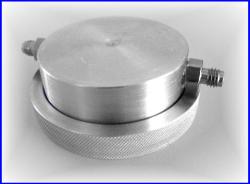
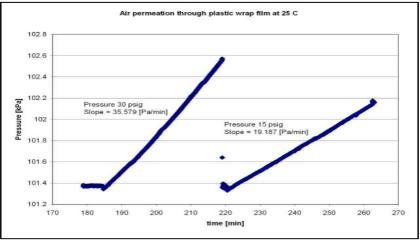
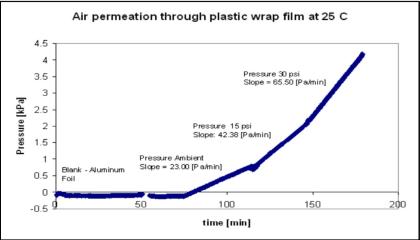
| Calculation of gas transport rates and permeability coefficient The volume Vc of the pycnometer chamber can be easily measured (as in regular true density measurements). Knowing the Vc , temperature, and applying the ideal gas law, the experimentally observed pressure rise versus time curve can be converted to volume V of gas (at STP) that permeated through the film or membrane, yielding the curve V versus time. Since the V is a product of permeability coefficient, effective area, pressure differential, and time divided by the thickness of the specimen, appropriate re-plotting of the curve yields the permeability coefficient as the slope. |
The HumiPyc can be easily employed as a gas permeability tester for
measurements of gas transmission rates through membranes, plastic
films, packaging materials, or other barriers. Instead of a dedicated
permeation analyzer, addition of sample holding adapters allows for
measurement of gas transport rates using manometric (pressure gradient)
method. Considering the 24-bit resolution (less than 0.01 Pa), ability to
change the volume of pycnometer sample chamber, and large pressure
differential, a wide range of gas permeation rates can be measured.
measurements of gas transmission rates through membranes, plastic
films, packaging materials, or other barriers. Instead of a dedicated
permeation analyzer, addition of sample holding adapters allows for
measurement of gas transport rates using manometric (pressure gradient)
method. Considering the 24-bit resolution (less than 0.01 Pa), ability to
change the volume of pycnometer sample chamber, and large pressure
differential, a wide range of gas permeation rates can be measured.
II. Gravimetric method of permeation and pervaporation measurements
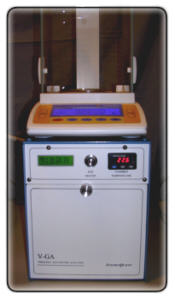
To carry out permeation measurements using this gravimetric sorption apparatus, the sample holding cell can be
suspended on the hang-down wire either in vertical or horizontal position. The unique design of the cell allows for
exposing the suspended membrane or film either to the vapor or to the liquid. Water or other (organic) liquids can be
used. Using dry gas or a humidified gas source (RH generator) with a regulated relative humidity level the
permeation or pervaporation process can be studied at different RH and temperature conditions. Using various RH
levels instead of dry gas only for circulating through the measuring chamber, unique profiles of mass changes vs.
time can be obtained. Those profiles are invaluable for researches studying the nature of transport processes
through membranes, plastic films, or other barriers.
suspended on the hang-down wire either in vertical or horizontal position. The unique design of the cell allows for
exposing the suspended membrane or film either to the vapor or to the liquid. Water or other (organic) liquids can be
used. Using dry gas or a humidified gas source (RH generator) with a regulated relative humidity level the
permeation or pervaporation process can be studied at different RH and temperature conditions. Using various RH
levels instead of dry gas only for circulating through the measuring chamber, unique profiles of mass changes vs.
time can be obtained. Those profiles are invaluable for researches studying the nature of transport processes
through membranes, plastic films, or other barriers.
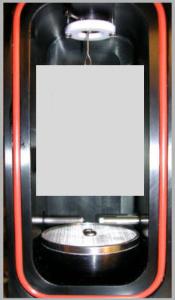
| Permeation Cell |
Several types of permeation experiments can be carried out:



| InstruQuest Inc. Scientific Instruments R&D |
 | |  | |  | |  | |  | |  |

| 2004 -2019 Copyright © InstruQuest, Inc. All rights reserved. |
