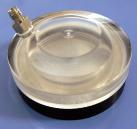
Universal Filter Holding Cell
(Shown with open-end transparent adapter)
Different filter areas and heights (packed beds) can be accommodated
(Shown with open-end transparent adapter)
Different filter areas and heights (packed beds) can be accommodated
Applications:
- High pressure filtering (w/ all metal parts)
- Forward flow testing
- Bubble point test
- Pressure decay test
- Evaluation of flow resistance to gas flow, from dry to 100%RH flow
- Envelope surface area analyzer
- Capillary porometer
- High pressure filtering (w/ all metal parts)
- Forward flow testing
- Bubble point test
- Pressure decay test
- Evaluation of flow resistance to gas flow, from dry to 100%RH flow
- Envelope surface area analyzer
- Capillary porometer
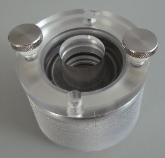
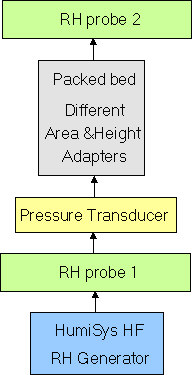
| Experimental setups using the Universal Filter Holding Cell |
| Setup 1. Forward flow testing setup (capillary flow porometers and envelope surface area analyzers data) |
| Setup 2. Packed beds and filter testing setup (capillary flow porometers, envelope surface area analyzers, and sorption data) |
| Adding Enhanced Bubble Point (active pore size determination) and Pressure Decay methods to the true density and moisture analysis capabilities of the HumiPyc |
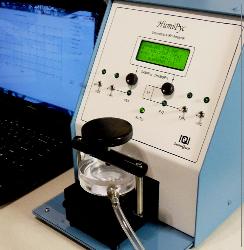
The unique design of the HumiPyc - gas (helium nitrogen, air) pycnometer and its closure of the sample chamber allow for additional
usage for testing of packed beds and filter integrity (bubble point, pressure decay methods). One of the assemblies depicted on the
photo below (with a paper filter inside) has transparent upper part for visual observation of the bubbles. The outlet from the chamber
can be connected to a flow meter to implement additional capabilities (forward flow method, capillary porometer).
usage for testing of packed beds and filter integrity (bubble point, pressure decay methods). One of the assemblies depicted on the
photo below (with a paper filter inside) has transparent upper part for visual observation of the bubbles. The outlet from the chamber
can be connected to a flow meter to implement additional capabilities (forward flow method, capillary porometer).
Please contact us at support@instruquest.com regarding inquiries for any application-specific requirements of the Bubble Point
and Pressure Decay analyzer.
and Pressure Decay analyzer.
The bubble point method is a commonly used technique for determination
of the largest pore(s), so-called active pores, in a given filter (membrane).
Experimentally, the bubble-point instrument measures the pressure needed
to blow gas (typically air) through the liquid filled medium. From the theory
of capillarity and using an ideal cylindrical approximation of real pores the
transitional pressure is reported as the pore diameter by employing this
simple formula:
d = 4σcosθ/p, where
d - (equivalent) pore diameter
σ - surface tension of the liquid
θ - liquid-solid contact angle
p - pressure at the first bubble(s) appearance
The nominator of the equation can be multiplied by shape/tortuosity factors
, e.g. the ASTM F316-86 method use a capillary constant of 0.715 value
of the largest pore(s), so-called active pores, in a given filter (membrane).
Experimentally, the bubble-point instrument measures the pressure needed
to blow gas (typically air) through the liquid filled medium. From the theory
of capillarity and using an ideal cylindrical approximation of real pores the
transitional pressure is reported as the pore diameter by employing this
simple formula:
d = 4σcosθ/p, where
d - (equivalent) pore diameter
σ - surface tension of the liquid
θ - liquid-solid contact angle
p - pressure at the first bubble(s) appearance
The nominator of the equation can be multiplied by shape/tortuosity factors
, e.g. the ASTM F316-86 method use a capillary constant of 0.715 value
- Pore diameter range from micrometers to millimeters
- Enhanced bubble point method
- Pressure decay (pressure drop) method
- Integration of density, pore analysis, and gas transport properties
- Programmable pressure rate increase
- High performance R&D tool for product testing and development
- Open-design for easy customization to address specific
requirements
- Excellent resolution for large pore sizes
- Temperature measurements of the externally located sample holder
- Minimal added cost compared to purchasing of a separate bubble
point or pressure decay tester
- Enhanced bubble point method
- Pressure decay (pressure drop) method
- Integration of density, pore analysis, and gas transport properties
- Programmable pressure rate increase
- High performance R&D tool for product testing and development
- Open-design for easy customization to address specific
requirements
- Excellent resolution for large pore sizes
- Temperature measurements of the externally located sample holder
- Minimal added cost compared to purchasing of a separate bubble
point or pressure decay tester
| Despite its conceptual simplicity, the bubble-point test must be implemented properly as the results depend on the rate of pressure increase, detection technique, liquid selection, temperature, and a particular instrumentation design (excluding the properties of the sample in question). Using the computerized and programmable pressure increase rate as well as the software and hardware capabilities of the HumiPyc, the bubble point technique can be enhanced to allow for determination not only the largest pore size but also the consecutive pore sizes that become active when the pressure is increased (very slowly). The example of the pressure value determinations for a filtering material is shown below. |
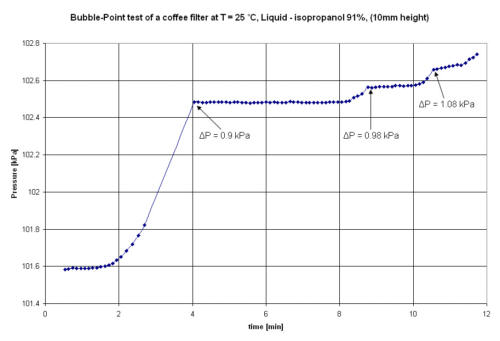
| An example of multiple pore sizes determination using slow pressure increase and high resolution pressure transducer detection technique |
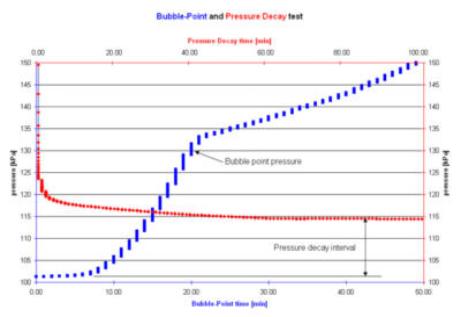
| An example of bubble point determination and pressure decay test for a high quality filter using water. For smaller size pores, the very slow pressure buildup is more essential in correct determination of the bubble point pressure. |
| To find out more about HumiPyc capabilities as filter integrity tester, please read this application note: "Combining the Enhanced Bubble Point and Pressure Decay methods in characterization of micro-filtration products using the HumiPyc." |
Advantages
The Bubble Point Method
| Before the bulk flow of gas appears on one side of the wetted sample in form of bubbles while the pressure is raised slowly, the diffusional mode of the gas transport takes place. In the pressure decay or pressure drop test, the pressure is raised to the vicinity of bubble point pressure and the flow of gas is cut off. From the rate of pressure drop versus time and the known initial volume of the gas, additional gas transport properties of the sample can be deduced. After initial fast decay, the pressure level tends to establish a plateau that stays relatively constant and the difference between the pressures on both sides of the sample can be used as another characterization parameter. |
Addition of the Bubble Point and Pressure Decay tests capabilities to the
HumiPyc requires only optional hardware for the sample holding as the
progressive gas dosing, all hardware, and the high resolution (24-bit)
data acquisition are already a part of the gas pycnometer. The sample
can be measured inside the temperature-controlled compartment of the
HumiPyc or it can be measured external to the instrument. The external
location of the sample holding hardware allows for larger spectrum of
samples to be measured and facilitates visual determination of the onset
of bubbles formation. The increase in gas pressure can be done
manually or automatically and the experimental data are graphed and
recorded. Considering the vast diversity of samples, their affinity
towards the wetting liquid, and the pressure spectrum employed, it is
recommended to combine the visual observations and the automatically
obtained data for the most reliable results of the bubble point method.
HumiPyc requires only optional hardware for the sample holding as the
progressive gas dosing, all hardware, and the high resolution (24-bit)
data acquisition are already a part of the gas pycnometer. The sample
can be measured inside the temperature-controlled compartment of the
HumiPyc or it can be measured external to the instrument. The external
location of the sample holding hardware allows for larger spectrum of
samples to be measured and facilitates visual determination of the onset
of bubbles formation. The increase in gas pressure can be done
manually or automatically and the experimental data are graphed and
recorded. Considering the vast diversity of samples, their affinity
towards the wetting liquid, and the pressure spectrum employed, it is
recommended to combine the visual observations and the automatically
obtained data for the most reliable results of the bubble point method.
The Pressure Decay Test
HumiPyc – Bubble Point & Pressure Decay Analyzer
 | |  | |  | |  | |  | |  |
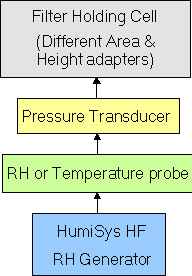
The forward flow testing setup employs the
universal filter holding cell and the
HumiSys HF RH generator with pressure
transducer. In its simplest implementation, the rate
of dry flow of gas versus pressure difference
across the sample (filter or packed bed) allows for
obtaining the data for gas flow resistance for filters
or determination of envelope surface area of
powders. Additionally, since the relative humidity
can be varied in a programmable way from dry to
fully wet conditions and back, the effect of
moisture on the flow resistance, caking effect, etc.
can be studied.
The ability of varying the RH allows for validation
of design of capillary porometers that employ only
the dry gas flow. The experimental observation of
different bubble point pressure versus the rate of
pressure buildup can be partially attributed to
drying of one surface of the filter by the dry gas.
The drying of the liquid in the interconnecting
pores changes the flow characteristics. In addition
to the dry run, repeated runs at different moisture
levels of the carrier gas can yield additional
characterization data. Using different wetting
liquids and the full RH scan, specific interactions
can be evaluated.
universal filter holding cell and the
HumiSys HF RH generator with pressure
transducer. In its simplest implementation, the rate
of dry flow of gas versus pressure difference
across the sample (filter or packed bed) allows for
obtaining the data for gas flow resistance for filters
or determination of envelope surface area of
powders. Additionally, since the relative humidity
can be varied in a programmable way from dry to
fully wet conditions and back, the effect of
moisture on the flow resistance, caking effect, etc.
can be studied.
The ability of varying the RH allows for validation
of design of capillary porometers that employ only
the dry gas flow. The experimental observation of
different bubble point pressure versus the rate of
pressure buildup can be partially attributed to
drying of one surface of the filter by the dry gas.
The drying of the liquid in the interconnecting
pores changes the flow characteristics. In addition
to the dry run, repeated runs at different moisture
levels of the carrier gas can yield additional
characterization data. Using different wetting
liquids and the full RH scan, specific interactions
can be evaluated.
The dual RH probes design of the
HumiSys HF RH generator and easy
addition of sensors, e.g. pressure
transducer, allows for a simple
implementation of a testing station for
packed beds or filters. Knowing the
rate of gas flow and monitoring the RH
probes data at a requested RH level,
the moisture holding capacity of a
given adsorbent can be measured as
well as reversibility of the process
under dynamic flow conditions.
Additional experimental data vs. RH
can be obtained compared to
envelope surface area analyzers and
capillary porometers.
HumiSys HF RH generator and easy
addition of sensors, e.g. pressure
transducer, allows for a simple
implementation of a testing station for
packed beds or filters. Knowing the
rate of gas flow and monitoring the RH
probes data at a requested RH level,
the moisture holding capacity of a
given adsorbent can be measured as
well as reversibility of the process
under dynamic flow conditions.
Additional experimental data vs. RH
can be obtained compared to
envelope surface area analyzers and
capillary porometers.

| InstruQuest Inc. Scientific Instruments R&D |


| 2004 -2021 Copyright © InstruQuest, Inc. All rights reserved. |